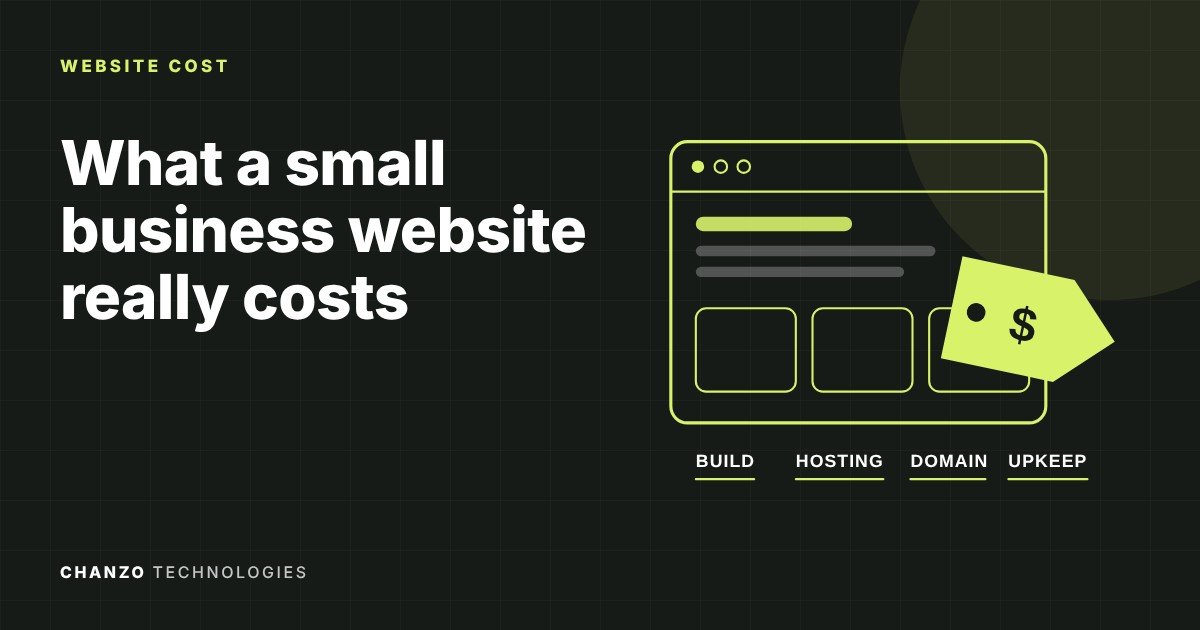
Ask three web designers what a website costs and you will probably hear three very different answers. That is normal, and it does not mean someone is lying to you. The final price depends on what you need the site to do, who builds it, how it is hosted and what happens after launch. This guide breaks a small business website cost into its parts so you can compare quotes fairly and spot what is missing from them.
The short answer
For a small business in Canada, published price guides commonly put agency-built sites in the low thousands of dollars. One Canadian guide lists a typical range of $3,000 to $8,000 for a small business site, and notes that more complete projects can climb well beyond that. The same guide cites ongoing hosting, security and maintenance at roughly $50 to $200 a month (Impeka, Web Design Pricing in Canada). Freelancers, templates and flat-fee studios can come in lower, and the trade-off is usually custom design, scope or support.
Treat every number you find online, including those, as a range to test against real quotes. Your project is not an average.
The four costs to ask about
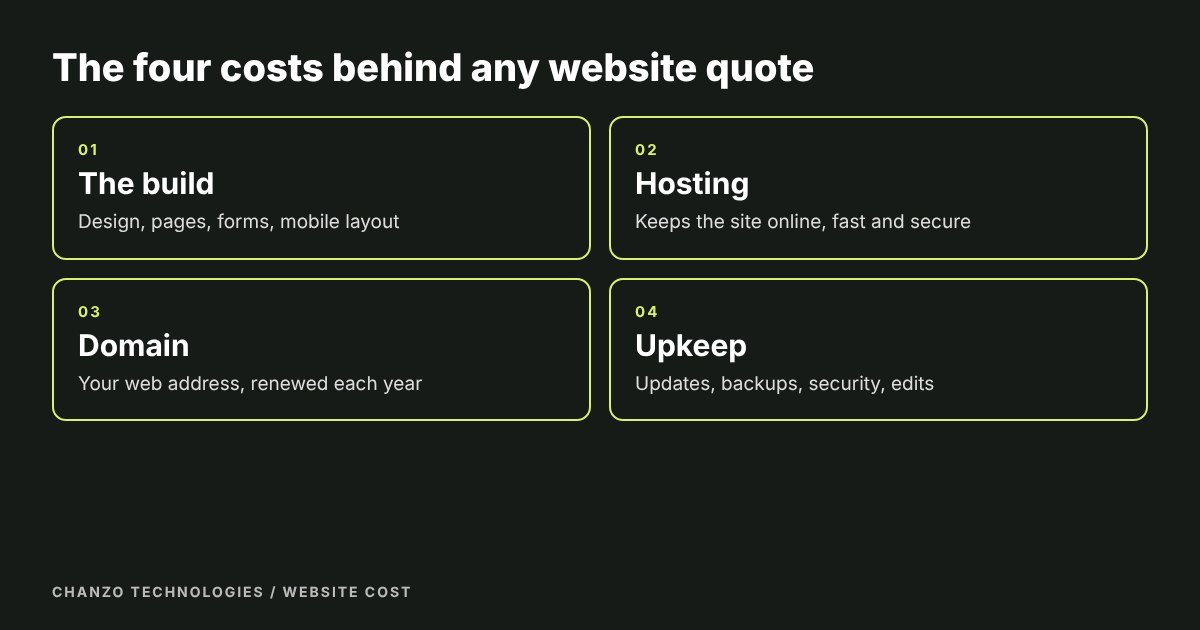
1. The build
This is the design and development work: the layout, the pages, how your copy is placed, forms and how the site behaves on a phone. Price moves with the number of pages, how custom the design is and any extra features such as online booking, payments or a member area. A five-page site for a local trade business is a very different job from a store with hundreds of products.
2. Hosting
A website has to live on a server that stays online and loads quickly. Hosting is a recurring cost, billed monthly or yearly. Very cheap hosting can mean slow pages and weaker security, which hurts both visitors and search rankings. Ask what is included: backups, security monitoring, an SSL certificate (the padlock that makes your site https) and how fast problems get fixed.
3. Your domain name
The domain (yourbusiness.ca or .com) is renewed every year, usually for a modest fee. The detail that matters is ownership. Make sure the domain is registered in your name or your company’s name, not the agency’s. That one fact decides who controls your website if you ever part ways.
4. Upkeep and support
Software needs updates, backups and security patches, and your business will change. Some studios include this, some charge by the hour and some leave you on your own. A site that is never updated gets slower and less secure over time. Before you sign, find out who will change your opening hours or add a new service in six months, and what that costs.
Three ways to pay, and who each suits
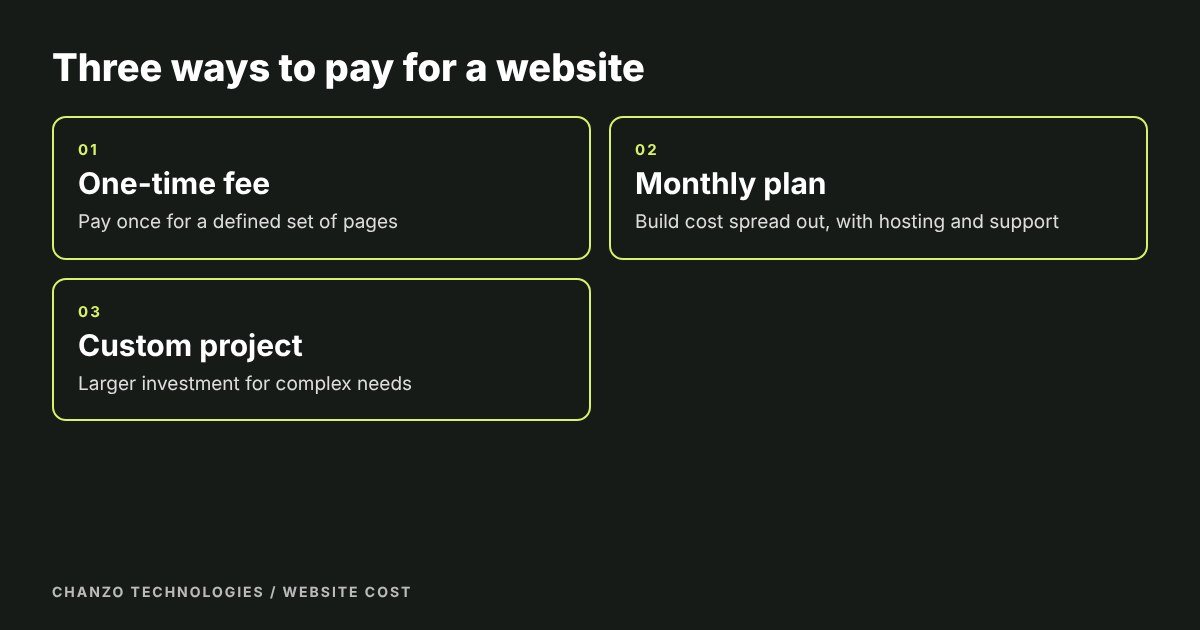
- One-time fixed price. You pay once for a defined set of pages. This suits an owner who wants a clean, professional site now and is comfortable handling updates, or paying for them as needed. The key question is what exactly is in scope.
- Monthly membership. The build cost is spread into a monthly plan that also covers hosting, support and sometimes ongoing search work. This suits owners who want to avoid a large upfront bill and want someone looking after the site. Read the term length, and what happens if you leave early.
- Large custom project. A bigger one-time investment for complex needs. It makes sense when the website is central to how you earn money, for example a booking system or an online store.
None of these is automatically better. A cheap one-time site that you never update can cost you more in lost enquiries than a monthly plan that keeps things current. A monthly plan you do not need is wasted money. Match the model to your time, your budget and how much help you want.
What changes the price the most
- Number of pages and templates. Each unique layout takes design and build time.
- Custom design versus a template. A tailored design costs more than a customized theme.
- Features and integrations. Booking tools, payment systems, CRMs and member areas add complexity.
- Content. Who writes the copy and sources the photos? Professional content is often worth the investment, but it is rarely free.
- Search optimization. Titles, descriptions, structure and speed work are part of a well-built site. Ongoing work is a separate service. See our search engine optimization page for how we approach it.
- Speed of approvals. Slow feedback stretches timelines and can add cost.
Questions to ask before you sign
- What exactly is included, page by page?
- Who owns the domain, the design files and the content?
- What are the ongoing costs after launch, and are they in writing?
- How many rounds of revisions are included?
- If I cancel, do I keep my site and my domain?
- Will the site be set up so Google can read it, with titles, descriptions and a sitemap?
- Will it work properly on a phone? Google now indexes the mobile version of your site first (Google Search Central).
Red flags in a quote
- A price that sounds free, with no mention of terms or ongoing fees.
- Vague scope: “a few pages” with no list.
- No clear answer on who owns the domain.
- Promises of a number one ranking. Google’s own guidance says no single tactic guarantees a top result (SEO Starter Guide).
- Pressure to decide today.
A simple way to compare quotes
Put each quote in a table with the same rows: build price, hosting, domain, support, revisions, term length and cost over 12 months. Adding the full year is the step most people skip. A low build price with high monthly fees can cost more than a higher build price with fees included. Compare the yearly total and what you actually receive for it.
How Chanzo prices it
Chanzo Technologies, a small business digital agency in Burlington, Ontario, offers two routes. One is a fixed-price website for a one-time fee. The other is the Free Build membership: your custom website is built at no build fee, and you pay a monthly plan for 12 months that includes hosting and your domain, with support and, on the higher plan, ongoing search work. Prices are in Canadian dollars plus tax. You can see what we build on our web design and development page.
Not sure which route fits? Tell us about your business and we will recommend one, even if that is not us. For a deeper comparison of the two options, read $500 website or monthly membership.
Frequently asked questions
Is a cheap website worth it?
It can be, if it does what you need and you know exactly what is and is not included. A low small business website cost becomes expensive when it leaves out hosting, mobile design, search basics or support that you then have to buy separately. Compare the 12-month total and the written scope, not the headline price.
Why do hosting and upkeep cost extra?
Because the work does not stop at launch. Servers have to stay online, software has to be updated and backups have to run. Some studios bundle these into a monthly plan and some bill them separately. Either way, ask for the numbers in writing.
Do I need a website if I already have social media?
Social profiles are useful, but you do not control them. A website is the one place you own, can rank in Google and can point every ad, card and listing to. Most customers who are about to spend money will check for one.
How long does it take to build a small business website?
A simple site can be live in a few weeks, depending on how quickly you provide content and approve designs. Larger projects with custom features take longer. Slow feedback is the most common cause of delays.
Will the website make me rank first on Google?
No honest provider can promise that. A well-built site gives you a solid base. Rankings depend on competition, content quality, reviews and consistent upkeep over time.
Where to find more help
If you are still planning the business itself, the Government of Canada has a hub of resources on permits, financing and registration at Canada.ca business and industry.
Price figures in this guide are general industry ranges, not a quote.