
If you run a shop, a trade business or a service company in Burlington, you have probably been told you “should be blogging.” The honest answer is that a small business blog is useful for some businesses and a waste of time for others. This guide helps you work out which group you are in, and what to do about it without giving up your evenings.
The short answer: it depends on how people find you
A blog is not a requirement for a good website. A clear homepage, solid service pages, a contact page that works and an up-to-date local search presence matter far more. A blog is an extra tool, and like any tool it only pays off when it fits the job.
A blog tends to help when customers research before they buy, when your service is explained better with detail, or when you want to answer the same questions once instead of fifty times. It tends to help less when customers simply search “plumber near me” and call the first trustworthy result.
Quick self-check
Answer these honestly:
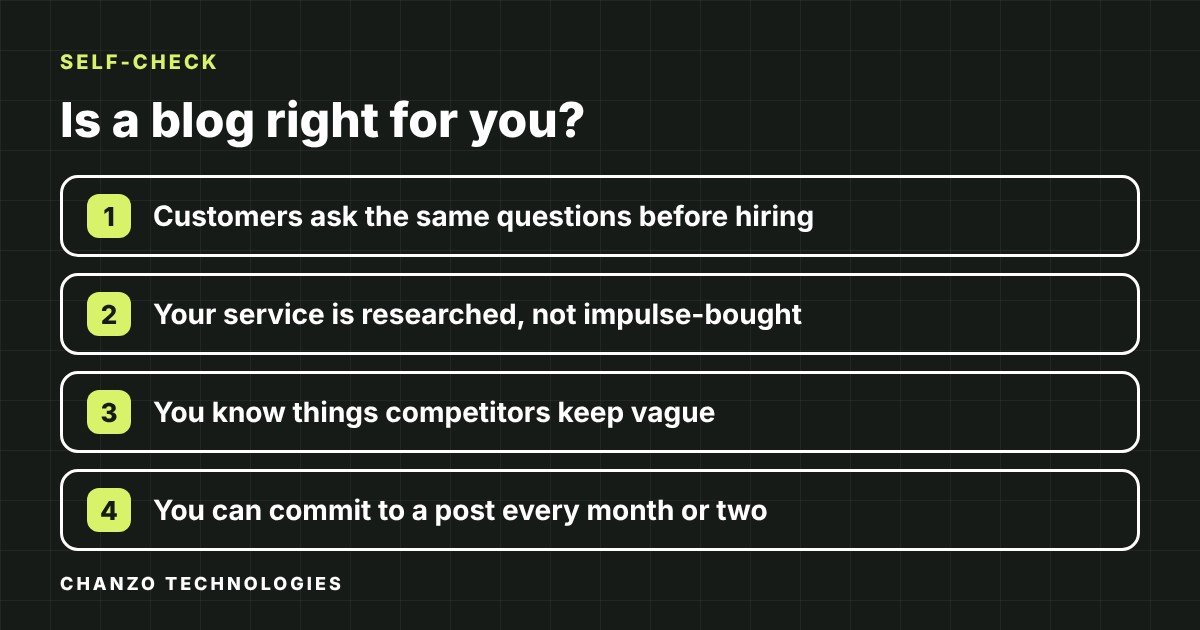
- Do customers ask you the same questions again and again before hiring you?
- Is your service something people compare or research for days or weeks (renovations, legal, accounting, health, events)?
- Do you have knowledge your competitors tend to keep vague, such as how pricing works or what the process looks like?
- Can you commit to one useful post a month, or even one every two months?
If you said yes to two or more, a blog is worth considering. If you said no to all four, put your effort into your core pages first.
What a small business blog can actually do for you
Answer questions before the phone call
Every business hears the same handful of questions: how long does it take, what does it cost, what happens first, what do I need to prepare. A post that answers one of those clearly saves you time and makes the next customer feel informed. You can also send the link in an email instead of retyping the answer.
Give search engines more to understand
Each post is another page that can show up when someone searches a specific question. Google’s own guidance says content should be created primarily to help people rather than to manipulate rankings, and that it should show real knowledge of the topic. You can read the details in Google’s page on creating helpful, reliable, people-first content. In other words, posts written from your actual experience are exactly what that advice describes.
Nobody can promise a particular ranking, and anyone who does should be treated with caution. Google also notes that changes can take anywhere from hours to several months to show up, as explained in its SEO starter guide. A blog is a slow, steady investment, not a switch.
Build trust with people who are not ready to call yet
Someone planning a project next quarter may read three of your posts today and call you in three months. A post that shows how you think, what you do and what you avoid is a quiet sales conversation that happens while you are on a job site.
Support the answers people get from AI tools
More people ask search tools and assistants questions directly. Clear, well-organized answers on your own site give those tools something accurate to draw from. We explain this in more detail in what answer engine optimization is.
When a small business blog is probably not worth it
Be realistic. A blog may be a poor use of your time if:
- Your website still has thin service pages, no clear phone number or no way to request a quote. Fix those first.
- You get nearly all your work from referrals and repeat customers, and nobody researches you online first.
- You do not have anyone who will write, edit or approve posts for months at a time.
- You would only be writing to fill space. One strong post beats ten generic ones.
An abandoned blog with a last post dated two years ago can make a business look inactive. If you start, keep the pace modest enough that you can keep it up.
Blog or service pages: which comes first?
Service pages almost always come first. They describe what you do and where, and they are the pages customers land on when they are ready to contact you. If you have not written them well yet, start with our guide on how to write a service page. Blog posts then support those pages by answering the questions around them.
| Page type | Job it does | Who it is for |
|---|---|---|
| Homepage | Explains who you are and where you work | Everyone |
| Service pages | Describe each service and make it easy to enquire | People ready to hire |
| Contact page | Makes getting in touch simple | People ready to act |
| Blog posts | Answer questions and build trust over time | People still researching |
What to write about: topics that work for local businesses
The best posts for a small business blog come straight from your day. You do not need clever ideas, you need honest ones.
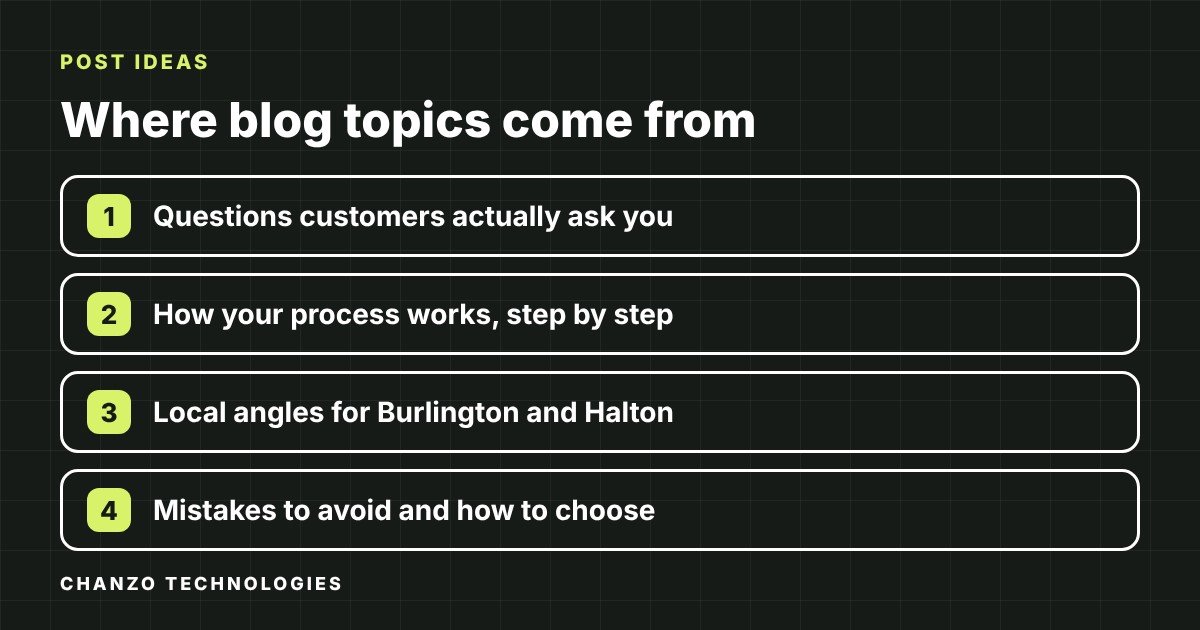
Questions customers actually ask
Keep a note on your phone. Every time a customer asks something, write it down. After a month you will have a list of post ideas with built-in demand.
How your process works
Walk readers through the steps from first call to finished job. People are more comfortable hiring when they know what to expect.
Local angles
Mention the places you actually serve, such as Burlington, Oakville, Hamilton or Mississauga, and local conditions that affect your work. If you are a landscaper, that might be how our winters change the way you plan a spring cleanup. Keep it accurate and specific to your own experience. For a broader look at building a local web presence, see our Burlington small business website guide.
Mistakes to avoid and how to choose
Posts like “five things to check before hiring a contractor” or “what to ask before you sign” help readers decide, and they show you are on their side.
How to run a small business blog without burning out
Set a rhythm you can keep
One post a month is plenty for most small businesses. Put it on your calendar like an appointment. Consistency matters more than volume.
Use a simple structure
Most good posts follow the same shape: a short intro that states the question, clear headings, short paragraphs, a list or table where it helps, and a closing line telling readers what to do next. Google’s guidance also encourages clear titles that describe the page accurately, and headings that break long text into sections.
Write the way you talk
Plain words win. If a customer would not say it out loud, rewrite it. You can tidy grammar afterwards, but do not lose your voice.
Link posts to the right pages
End each post by pointing readers to the page that matches their next step, such as a service page or your contact page. A post that does not lead anywhere is a missed opportunity.
Update old posts
Check your posts once or twice a year. Fix prices, hours, names and anything that has changed.
A simple checklist before you hit publish
- The post answers one clear question.
- The title says what the post is about in plain words.
- The first paragraph tells the reader what they will learn.
- Headings break the post into scannable sections.
- Every claim is something you know to be true from your own work or a source you checked.
- There are no made-up quotes, reviews or statistics.
- The post links to at least one service page or your contact page.
- Your phone number and a way to enquire are easy to find on the page.
What if you do not have time to write?
Many owners fall into this group, and that is fine. You have three realistic options:
- Write short posts yourself. Four to six paragraphs answering one question is enough.
- Record your answer, then clean it up. Talk through the answer on your phone and edit the transcript into a post.
- Get help. A web partner can structure, edit and publish your posts for you, while the ideas and facts still come from you.
Whichever you pick, the knowledge has to come from you. That is what makes a blog worth reading.
Frequently asked questions
Does every small business need a blog?
No. A blog helps most when customers research before hiring or ask the same questions repeatedly. If most of your work comes from referrals and quick local searches, strong service pages and a complete Google Business Profile will usually matter more.
How often should I post?
Choose a pace you can sustain. One useful post a month is a reasonable target for most small businesses. A steady, modest schedule is better than a burst of posts followed by silence.
Will a blog get me to the top of Google?
No one can guarantee a ranking, and results can take months. A blog gives you more helpful pages that search engines can understand and more ways for customers to find you, but it is one part of a wider plan.
How long should a blog post be?
Long enough to answer the question properly and no longer. Some topics need 500 words, others need 1,500. Focus on being clear and complete rather than hitting a word count.
Can I add a blog to my existing website later?
Usually yes. Most modern websites can add a blog section without a rebuild. If you are unsure, get in touch and we will take a look at your current site.
Where to go from here
Start with the basics: clear service pages, an easy way to contact you and an accurate local presence. Then, if the self-check above told you a small business blog fits your situation, begin with one post that answers your most common customer question.
If you need a website to build on, Chanzo Technologies has two options for Burlington and Halton businesses. The first is a fixed-price website for $500 CAD plus tax. The second is the Free Build membership: a custom website with no build fee, followed by a monthly plan for 12 months at CAD 349 (Growth) or CAD 500 (Partner), plus tax, with hosting and domain included. Partner adds ongoing SEO. Compare them in our $500 website vs monthly membership guide, see our web design and development services, or contact us to talk through what makes sense for your business.