
More people now ask questions to AI assistants, voice assistants and search features that reply with a direct answer instead of a list of links. Answer engine optimization, or AEO, is the practice of making your website easy for those systems to read, trust and quote. If you run a small business, the good news is that AEO is mostly good website practice done carefully. This guide explains what it is, how it differs from SEO, and the steps worth your time.
What is answer engine optimization?
An answer engine is any system that responds to a question with a direct answer: an AI chat assistant, a voice assistant, or the summary boxes that appear at the top of some search results. Answer engine optimization means structuring your content so those systems can find the answer on your page, understand it and, where appropriate, use it.
It does not replace search engine optimization. It adds a sharper focus on questions and answers. Our search engine optimization service covers both, because the foundations are the same.
How AEO differs from traditional SEO
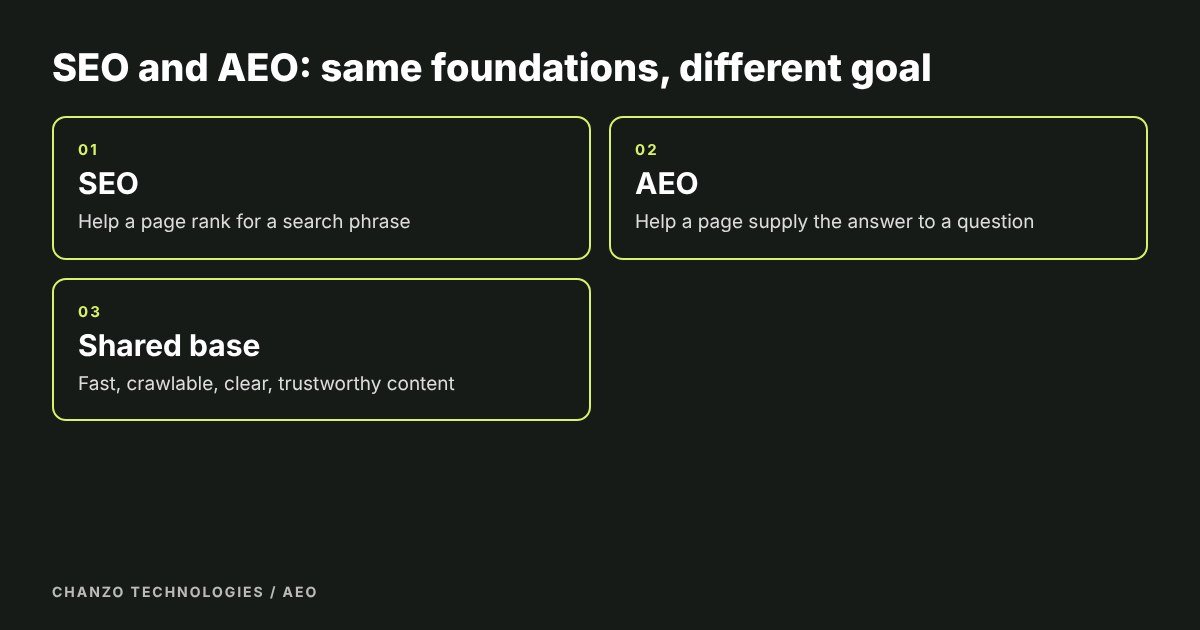
Traditional SEO focuses on helping a page rank for a search phrase. AEO focuses on helping a page supply the answer to a specific question. The overlap is large. A fast, crawlable, well-structured site with genuinely helpful content serves both. Google’s guidance on creating helpful, reliable, people-first content is a good statement of the shared goal (Google Search Central).
The differences are mostly in format:
- Traditional SEO asks, “Which phrase should this page rank for?”
- AEO asks, “Which question does this page answer, and how clearly?”
- AEO pages lead with the answer, while many SEO pages build up to it.
- AEO leans on question headings, FAQs and structured data to label the parts of a page.
Practical steps that help
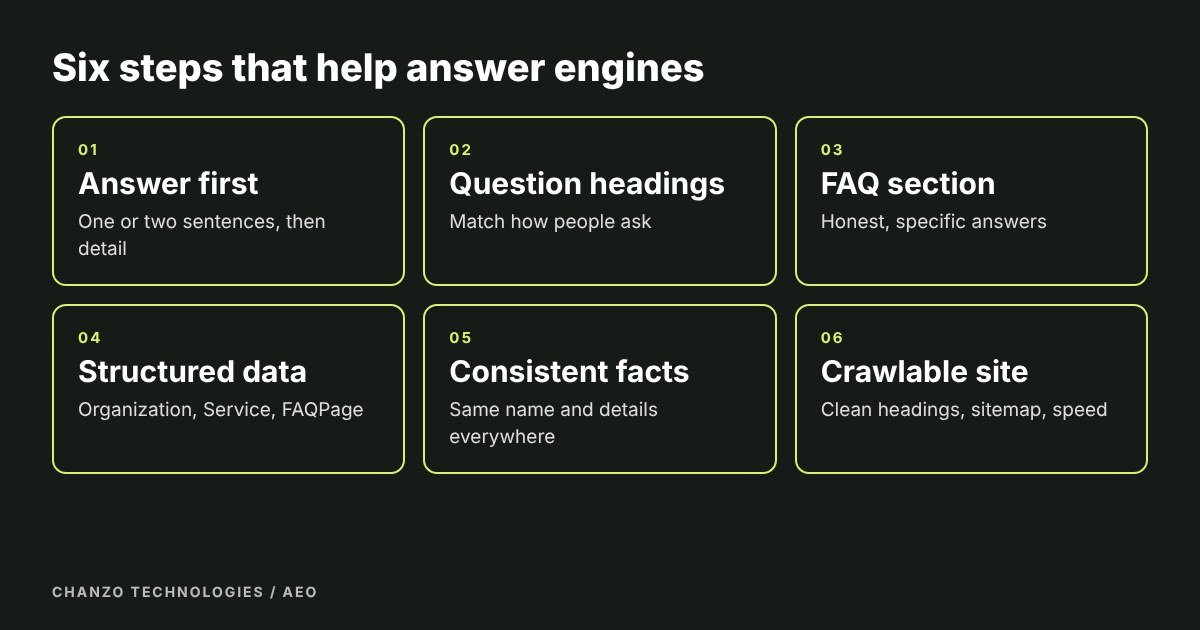
1. Answer the question first
Open a section with a one or two sentence answer, then add detail underneath. A reader in a hurry gets what they need, and a machine can see where the answer sits. For example, under the heading “How long does a website take?”, begin with the typical timeframe and then explain what can speed it up or slow it down.
2. Use real questions as headings
Phrases such as “How much does a small business website cost?” match how people actually ask. Write your headings the way a customer would say them out loud. You can find the questions by listing what customers ask on calls, in emails and in reviews.
3. Add an FAQ section
An FAQ with honest, specific answers to the questions your customers repeat is one of the most effective AEO tools. Keep each answer short and direct. Avoid filler and avoid answers that only say “contact us”.
4. Use structured data
Schema markup such as Organization, Service and FAQPage tells machines what each part of a page means. Google explains how structured data helps it understand a page and can enable richer results, and it recommends the JSON-LD format (Introduction to structured data). Many website themes and SEO plugins can add the basics. Make sure the markup matches what is visible on the page.
5. Keep facts consistent
Your business name, services, service area and contact details should match everywhere they appear: your website, Google Business Profile and directory listings. Contradictions make it harder for any system to trust your information. For a local example, see our Burlington small business website guide.
6. Make the site crawlable
Clean headings, descriptive links, fast loading and an up-to-date sitemap still matter most. A sitemap helps search engines crawl your key pages efficiently (Google Search Central). If a system cannot reach or read your page, nothing else on this list helps.
A simple example
Imagine a plumber’s service page. A weak version opens with a slogan and a paragraph about the company’s history. A stronger version opens with “We repair and replace residential water heaters in Burlington, Oakville and Milton, usually with same-week availability.” Then it lists what is included, how pricing works and a short FAQ: “Do you offer emergency service?”, “How long does a replacement take?”, “Do you remove the old unit?” Every one of those answers is something an assistant could quote, and something a customer wants to know.
We cover the page structure in detail in how to write a service page.
What AEO cannot do
No one can guarantee that an AI assistant will mention your business. These systems change often, and each decides for itself what to cite. Be cautious of anyone who promises a specific result. Google itself says no single tactic guarantees a top ranking (SEO Starter Guide). The reliable approach is to publish clear, accurate, useful pages and keep them current.
Does your website need it?
If customers ask questions before they buy, yes, and the work is mostly good content practice: clear answers, clear structure and clear facts. Start with your most important service page and your most common customer questions. If you are about to build or rebuild a site, ask your designer to build these in from the start. Our web design and development work does.
A quick AEO checklist
- Each key page answers a specific question near the top.
- Headings are written as real questions where it fits.
- An FAQ covers the questions customers repeat.
- Structured data is in place and matches the page.
- Name, address, phone and services are identical everywhere.
- Sitemap submitted, pages fast, and nothing important blocked.
- Pages reviewed and updated at least a few times a year.
Frequently asked questions
Is AEO the same as SEO?
No, but they overlap heavily. SEO helps a page rank. AEO helps a page give a clear answer. Good SEO foundations support both.
Do I need special software for AEO?
Not necessarily. Clear writing, good headings, an FAQ and basic structured data cover most of it, and many website platforms can add the markup.
Will AEO get me cited by AI assistants?
It improves your chances of being understood, but nobody can promise citations. Treat it as making your site easier to use, not as a guaranteed channel.
How long does it take to see an effect?
Changes can be picked up within days or weeks, but visibility depends on competition and how often systems revisit your pages. Think in months, not days.
Where should a small business start?
With the service page that brings in the most work. Add a clear opening answer, an FAQ and consistent contact details, then repeat for the next page.
Want help?
Chanzo Technologies is a small business digital agency in Burlington, Ontario. We build websites with clear structure and look after the search work afterwards. Tell us about your business and we will suggest where to begin.